Midlands-based Black Space Technology supported a landmark Mount Everest expedition that saw the first mixed gender team of British Army Reservists successfully reach the summit of Everest. Through the deployment of its Rapid EPR telemedicine kit, the company demonstrated how advanced medical technology can enable first-class delivery of healthcare into any environment.
The expedition was led by the Honourable Artillery Company (HAC), incorporated by royal charter in 1537 by King Henry VIII and the oldest regiment in the British Army. The eight-person climbing team from the HAC was supported by two medical staff. Birmingham-based Black Space Technology, who specialise in telemedicine and point-of-injury solutions, partnered with Iqarus, part of the International SOS group. Iqarus deployed an experienced expedition paramedic to work alongside the expedition’s clinical lead, providing embedded medical support and continuous clinical oversight throughout the ascent. A single Rapid EPR kit was deployed to ensure continuous medical monitoring and effective medical care in extreme and remote conditions.
The portable Rapid EPR kit enabled climbers’ vital signs to be recorded twice daily, allowing medical staff to identify early signs of deterioration as the team ascended. This regular data collection made it possible to identify trends, providing two to three days’ notice of potential health deterioration and enabling early medical intervention.
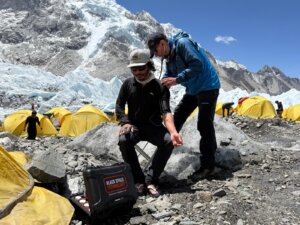
Medical support was delivered continuously at altitude, enabling clinicians to build a comprehensive picture of individual health by combining vital sign data with observed symptoms and physical condition. This proved particularly valuable during the approach to base camp, where some team members experienced sickness and gastrointestinal illness. Proactive intervention allowed hygiene measures to be reinforced, treatment to be provided, and recovery to be closely monitored, ensuring individuals were stabilised before further ascent.
Beyond the immediate climbing team, the Rapid-EPR unit was also used at base camp to assess and monitor the health of Nepalese Sherpas, many of whom have limited access to routine healthcare. This support proved especially valuable following a recent increase in Khumbu cough cases on Everest. For many Sherpas, access to medical assessment remains limited due to the remoteness of their working environment.
A key capability of the Black Space Technology kit was that it was the only medical equipment at base camp equipped with a defibrillator. In the event of cardiac arrest, this capability had the potential to make a critical difference to patient outcomes in an environment where evacuation options are extremely limited.

The insulated, robust, and self-contained design of the kit allowed it to be easily transported and deployed across the mountain. Insulation helped prevent rapid battery discharge in extreme cold, while integrating communication and monitoring into a single system simplified logistics and reduced equipment burden in a high-risk environment.
The deployment of Black Space Technology solutions during the Everest expedition highlights how portable telemedicine systems can enhance medical monitoring, improve safety, and extend access to healthcare in some of the world’s most challenging environments.
Article provided by Black Space Technology. Contact email: [email protected]