Midlands-based Black Space Technology is leading a new international healthcare innovation project aimed at transforming access to eye diagnostics in remote and underserved communities. The Birmingham company, whose core expertise is telemedicine and point-of-injury patient monitoring, is working in partnership with Birmingham City University and Japanese ophthalmic hardware specialist OUI Inc (Japan)., with support from Innovate UK and the Eureka Network through the UK–Japan Globalstars programme.
Together, the partners are developing a next-generation, AI-enhanced digital slit lamp integrated with a secure telemedicine platform. Black Space Technology is leading the telemedicine integration, Birmingham City University is advancing the artificial intelligence for image analysis and early disease detection, and OUI Inc. is delivering the specialist modular hardware design.
The portable diagnostic device will work with Android smartphones and combine advanced imaging, AI-driven decision support and low-bandwidth connectivity. This will enable frontline healthcare workers to carry out high-quality eye examinations in locations where access to ophthalmologists and traditional diagnostic equipment is limited.
Blindness and vision impairment affect more than two billion people globally, with a significant proportion of cases being preventable through early diagnosis. By lowering the cost and complexity of specialist eye diagnostics, the project directly addresses major barriers to care and supports the World Health Organization’s Vision 2030 ambition to reduce avoidable blindness.
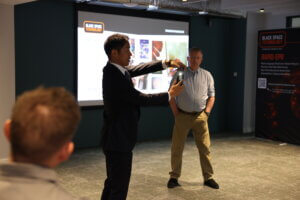
The project kick-off meeting brought together partners from across industry and academia at Black Space Technology’s 10X Spacemade offices in Birmingham. Participants from Black Space Technology included David Morgan (Chief Executive Officer), Daniel Opoku (Senior Product Manager), and Davinder Sidhu (Finance Director). Birmingham City University attendees included Umar Daraz (Director of Innovation), Junaid Arshad (Head of Computing), De Mi (Associate Professor), and Martin Esugo (Research Fellow – Data and AI), while OUI Inc was represented by Shintaro Nakayama (Chief Operating Officer). Additional attendees included Richard Woodland (Birmingham City Council), Max Chong Li (Columbia University), and Jason Wing (Paramedic, Iqarus and HAC Everest Expedition 2025).
David Morgan, CEO of Black Space Technology, said:
“The SIGHT-AI project shows what is possible when regional innovation is combined with international collaboration. By working closely with Birmingham City University and OUI Inc., and with the backing of Innovate UK and the Eureka Network, we are developing a practical, scalable diagnostic solution that can support clinicians both here in the UK and globally, while reinforcing the Midlands as a centre for medical technology innovation.”